AI Weekly Recap, GrokBot, ChatGPT Redesign and Claude Cowork
Want articles like this for your own video to promote it on YouTube and Google? Order them through the Telegram bot @sat_sit_bot. It writes articles around your video, embeds the video and publishes them on popular niche websites (no ads). Try it free: 50 articles on us.
· based on the channel Paul J Lipsky
Key takeaways
- GrokBot is reportedly planning to route tasks to third-party tools including Claude, Midjourney and Suno instead of building every capability in-house.
- ChatGPT rolled out a redesigned interface the channel calls the Intelligent UI, changing how models and tools are surfaced in the chat window.
- Anthropic moved Claude Cowork to the cloud and shipped Claude Haiku 5.5, extending agent-style collaboration beyond the desktop.
- Google adjusted Gemini subscription plans and pushed Nano Banana 2.1, while its Playground environment got a hands-on test.
- The recap was published on 9 October 2026 by Paul J Lipsky and is sponsored by Okou, with a 20% promo code for Pro or Team plans.
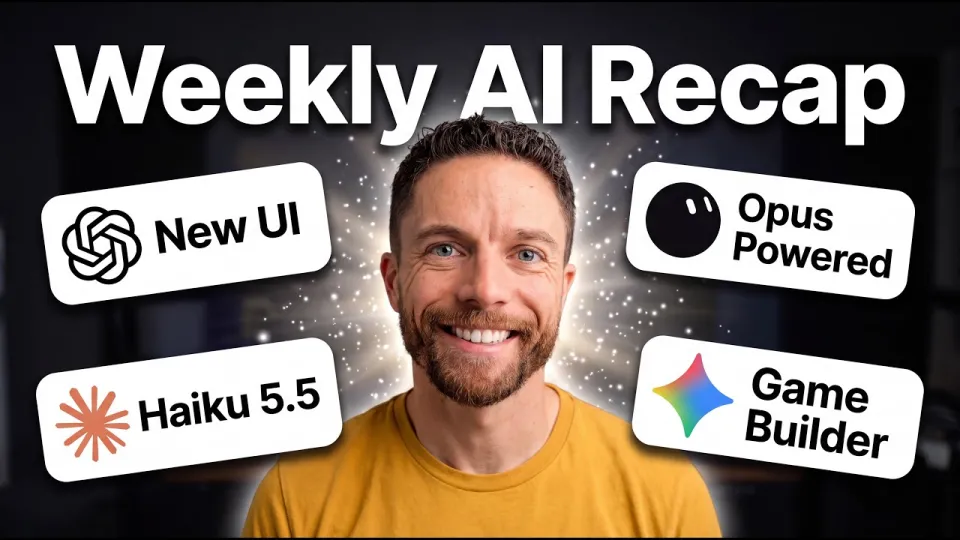
The past week in AI came down to three moves: GrokBot openly planning to lean on rival models such as Claude, Midjourney and Suno; ChatGPT shipping a redesigned Intelligent UI; and Anthropic pushing Claude Cowork into the cloud alongside Claude Haiku 5.5. Paul J Lipsky walks through all of it in his weekly recap, and viewers who want to try the sponsor's agent platform can sign up for Okou with promo code `KJZN8RVG` for 20% off one month of a Pro or Team plan, limited to 100 redemptions.
GrokBot's plan to borrow Claude, Midjourney and Suno
GrokBot is positioning itself less as a single model and more as a router that hands specific jobs to the best available tool, and that list now reportedly includes Claude for reasoning-heavy work, Midjourney for images and Suno for audio. The logic is straightforward: instead of training every capability from scratch, an agent orchestrates specialist services and returns one finished result to the user.
That framing matches what early users are already doing with it. One viewer described handing a Grok Bot a shared folder of business videos, giving it instructions for a social clip, receiving a voice script, recording that script and feeding it back — and getting a result they rated above the work they had been paying a contractor for. That is a full production loop: asset intake, scripting, voice, edit. It also explains why the "which model is underneath" question matters less than "which tool did the agent pick, and can I see why."
Practical implications if you plan to use an orchestration-first bot:
- Keep source assets in a folder you can share by link, since agents work best with a stable input location.
- Write instructions as a brief, not a command — format, length, tone and platform.
- Expect a script back before a finished video; the human voice-recording step is often where quality is won.
- Check licensing terms for anything generated by a third-party image or music service.
ChatGPT's Intelligent UI changes the chat window
ChatGPT looks different because OpenAI reworked the interface around what the recap calls the Intelligent UI, shifting the product from a blank text box toward a surface that surfaces models, tools and context on its own. For regular users the visible change is layout; the functional change is that the system decides more often which capability to invoke, rather than waiting for a prompt that names it.
That has a real cost and a real benefit. The benefit is fewer wasted prompts for people who never learned which mode to select. The cost is less transparency about why a given answer arrived in a given form, which is exactly the kind of thing power users notice first. If you rely on ChatGPT for repeatable work, the safe habit is to state the output format and constraints explicitly even when the interface offers to choose for you.
Anthropic: Claude Cowork goes cloud, Haiku 5.5 arrives
Claude Cowork moving to the cloud is the more consequential Anthropic change of the week, because it decouples collaborative agent work from a single machine. Cowork is built around the idea of an assistant that works alongside you on shared tasks rather than answering one prompt at a time; hosting it in the cloud means those sessions can persist and be reached from more than one device.
Claude Haiku 5.5 landed in the same stretch. Haiku has historically been the fast, cheap tier of the Claude line, which makes a point release there relevant for high-volume work — classification, extraction, drafting at scale — rather than for the heaviest reasoning jobs. Pairing a lighter model with a cloud workspace is a coherent pitch: cheap iteration inside a persistent environment.
One theme keeps surfacing in the audience: people want Claude Code explained for non-technical users. That request appeared repeatedly under the recap, and it points at a genuine gap — the tooling has moved faster than the documentation aimed at people who do not write software.
Google: Gemini plan changes, Nano Banana 2.1 and a Playground test
Google's week was about packaging as much as capability. Gemini subscription tiers were adjusted, and one viewer flagged a detail worth knowing: the AI Plus plan bundles 2 TB of storage alongside access to Google's Pro model, which changes the value math for anyone already paying for cloud storage separately. If you are comparing tiers, price the storage component before deciding the AI features are the expensive part.
Nano Banana 2.1, the next iteration of Google's image generation and editing line, also appeared. The version bump matters most for editing consistency — keeping a subject recognizable across changes — which is the part of image work that usually breaks first. The recap also includes a hands-on test of Google Playground, the experimental surface where Google exposes new interaction patterns before they reach the main products. Treat anything you build there as provisional.
Common questions from people following this week's AI news
The most frequent confusion is about bots that appear unannounced. One viewer found an unfamiliar agent in their account, assumed another bot had gone rogue, deleted it, and later could not get it back. The lesson is procedural: before removing an unfamiliar agent, check whether it is a platform-provided default, and screenshot its settings so you can reconstruct it.
A second recurring question is how much of this matters for non-developers. The answer is more than the coverage suggests — the Grok Bot production example above required no code, only a folder, a brief and a voice recording. The barrier is knowing what to delegate, not syntax. A third thread is skepticism about hype, and it is healthy: an agent that routes to Claude, Midjourney and Suno is a coordination layer, not a new intelligence, and it should be judged on finished output.
What this week signals about AI agents
The through-line across GrokBot, ChatGPT, Claude Cowork and Gemini is that the interface, not the model, is becoming the product. Orchestration layers that quietly pick a specialist tool are winning attention because they shorten the path from intent to artifact. The trade-off is legibility: the more the system decides, the more you need to specify what "done" looks like.
For anyone building a workflow this month, the useful move is to pick one repeatable task, run it through two different agents, and compare the finished files rather than the chat transcripts. That test survives interface redesigns, plan changes and version bumps — all of which arrived in a single week.
Conclusion
The week's AI news is best read as a shift in packaging: GrokBot borrowing Claude, Midjourney and Suno, ChatGPT rebuilding its interface, Claude Cowork leaving the desktop, and Google reshuffling Gemini tiers around storage. None of these is a new frontier model, and that is the point — the competition has moved to how work gets routed and finished. Paul J Lipsky's weekly recap is a useful way to track that shift without reading every changelog, and his deep dives on individual tools are worth following if you want the detail behind the headlines. If you want to test an agent platform yourself, register with Okou and use code `KJZN8RVG` for 20% off one month of Pro or Team, while the 100 redemptions last.
Questions & answers
What did GrokBot actually do that was described as unthinkable?
According to the recap, GrokBot is planning to route tasks to third-party tools including Claude, Midjourney and Suno rather than building every capability in-house. The notable part is a competing AI company's model being used inside Grok's agent stack. It reframes the bot as an orchestrator rather than a single model.
What is ChatGPT's Intelligent UI and does it change how I prompt?
It is a redesigned interface that surfaces models and tools more actively instead of presenting a plain text box. The system takes on more of the decision about which capability to use. Practically, you should still state your desired output format and constraints explicitly, since the interface may choose a mode you did not intend.
Is Claude Cowork now fully cloud-based?
The recap covers Anthropic moving Claude Cowork to the cloud, which lets collaborative agent sessions persist beyond one machine. Claude Haiku 5.5 also shipped in the same period. Check Anthropic's own documentation for current plan availability and limits before migrating a workflow.
Why did Google change Gemini plans and what is Nano Banana 2.1?
Gemini subscription tiers were adjusted, and one viewer noted that the AI Plus plan includes 2 TB of storage plus access to the Pro model, which matters if you already pay for storage. Nano Banana 2.1 is the next version of Google's image generation and editing line, with the biggest gains typically in edit consistency.
Source: Weekly AI Recap: GrokBot Just Did the Unthinkable, ChatGPT Looks Completely Different & More! · Markdown version